“Zosia’s Fragile Beginning — A Tiny Fighter’s Battle for Life”
When we learned we were expecting twins, it felt like a dream come true.
We were the happiest people on earth.
Every ultrasound, every heartbeat, every tiny kick brought joy beyond words.
Our lives suddenly had a new rhythm — one that pulsed with excitement, plans, and hope.
The doctors were calm, the tests looked good, and the pregnancy seemed perfect.
We pictured the day we’d finally hold our two little girls — healthy, rosy-cheeked, wrapped in soft blankets.
We imagined laughter, lullabies, and matching dresses.
Everything was ready.
Until the 28th week.
When the Dream Shattered
It was supposed to be just another routine ultrasound.
But the doctor’s smile faded.
Her voice grew serious.
She said the words no parent ever wants to hear:
“You need to go to the hospital immediately.”
My heart began to race.
Something was wrong — terribly wrong.
Within hours, we were admitted, surrounded by monitors and machines.
Our twins were in distress.
Each day brought new tests, new numbers, new fears.
The doctors tried everything, but their faces told the truth before their words did.
After a week of fighting to keep the pregnancy stable, they made the decision —
an emergency C-section was the only way to save them.
At 28 weeks, two and a half months before their due date, our daughters were born.
The delivery room was silent — too silent.
There were no cheers, no congratulations, no joyful cries.
Only the sound of machines, hurried footsteps, and whispered medical commands.
The First Days of Life — Between Hope and Despair
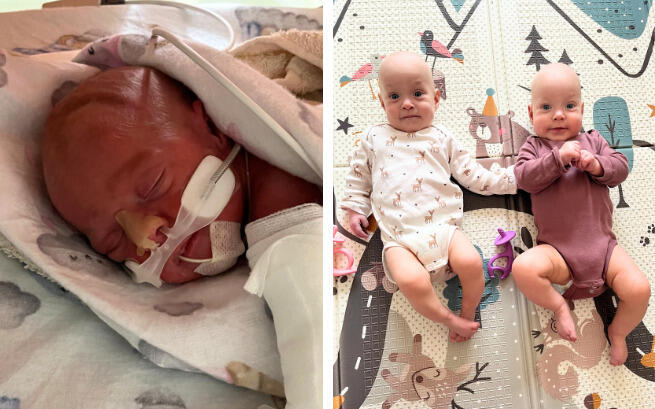
Our girls were born so tiny, so fragile, their skin almost translucent.
They weighed less than a bag of sugar.
Their lungs were not ready for the world, their hearts too weak to keep up.
Both were rushed to incubators and immediately intubated.
Machines breathed for them.
Monitors replaced lullabies.
We stood outside the neonatal intensive care unit, staring through glass, watching our babies fight for every breath.
Our first daughter, Marysia, was struggling but stable.
She needed long-term respiratory support, but the doctors were optimistic.
Then there was Zosia — her condition was far worse.
In her ninth day of life, she suffered a
collapsed lung and a severe sepsis infection.
Her body, so small and delicate, trembled under the weight of tubes and needles.
We were told to prepare for the worst.
I remember pressing my forehead against the glass, whispering through tears, “Please, my little girl, don’t go.”
There was nothing else we could do.
We had to trust the doctors, trust her strength, and hope for a miracle.
When Fear Became Our New Normal
For weeks, we lived between two worlds — the world outside the hospital, where time stood still, and the world inside, where life hung by a thread.
Each day began with the same question: “Is she still with us?”
The doctors were kind, but their updates were always cautious.
And then, just when we thought things couldn’t get worse, they discovered more.
A heart defect.
And irreversible brain damage caused by oxygen deprivation.
I can still feel that moment — the sound of the words echoing in the sterile hospital room, the way the ground seemed to disappear beneath my feet.
We were crushed.
I wanted to scream, to run, to wake up from this nightmare.
But instead, I held my husband’s hand and said the only thing that made sense:
“We will fight for her. Whatever it takes.”
A Long Road Home
After weeks of watching machines keep our daughters alive, we were finally allowed to bring them home.
But home was not the end of our journey — it was the beginning of another.
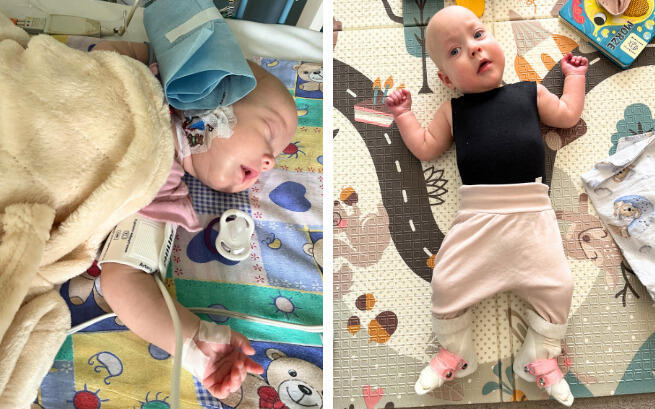
Zosia came home with a long list of diagnoses and an even longer list of therapies.
She was weaker, smaller, quieter than her sister.
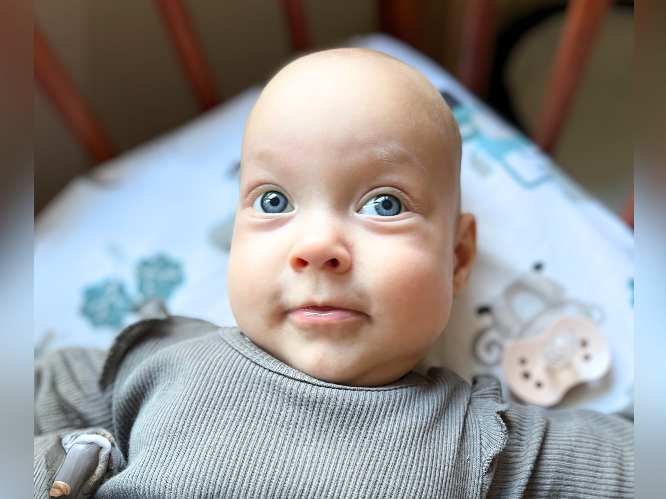
But her eyes — bright, curious, determined — told us she wasn’t giving up.
From that day, rehabilitation became part of our everyday life.
Zosia works with therapists five times a week, learning how to move, how to control her tiny hands, how to hold her head.
She suffers from psychomotor delay, and without constant exercises, she might never walk or speak properly.
In July, she underwent heart surgery — her little chest scarred, but her spirit unbroken.
Since then, we’ve spent countless hours traveling to appointments with cardiologists, neurologists, osteopaths, orthoptists, and ophthalmologists.
Each visit brings both hope and anxiety — what if they find something new?
The binder of her medical documents is so thick now that it barely closes.
It’s a record of every battle she’s fought and survived.
But every page is also a reminder that our fight is far from over.
The Cost of Survival
Raising a child with complex medical needs is a constant balancing act between love and fear, strength and exhaustion.
We celebrate small victories — a laugh, a new word, a tiny step forward — but behind every smile lies the shadow of hospital bills and sleepless nights.
The therapies, the equipment, the travel, the medications — they all come with costs we can barely manage.
We’ve learned to live without luxuries, to measure time in therapy hours and money in medical invoices.
But we would give everything — every penny, every ounce of strength — if it means Zosia will one day walk on her own.
We believe she can.
We’ve seen her courage.
When she tries to lift her hand, when she struggles to sit up, when she smiles through tears — that’s her way of saying, “Don’t give up on me.”
Hope Has Her Name
Zosia’s name means “wisdom” in our language — but to us, it also means hope.
Hope that one day she will run beside her sister.
Hope that her laughter will fill our house instead of the hum of medical machines.
Hope that this story will have a happy ending.
We know we can’t do it alone.
The road ahead is long, and the expenses keep growing, but our hearts are full of faith that kindness can change everything.
If you choose to help us — by donating, by sharing her story, by simply believing in her — you’ll be part of something beautiful.
You’ll be helping a little girl who’s already fought more than most adults ever will.
Because even though her start in life was fragile, her spirit is stronger than anyone could imagine.
